
Predicting Race Shape: The Ultimate Guide to Live Pace Mapping & Scenario Alerts
The single biggest blind spot for traditional form punters is failing to predict how a race will actually be run. A horse can possess the highest raw speed ratings in the field, but if they get trapped in a heavily contested pace battle or stuck behind a wall of slow horses on a sharp track, their winning chances evaporate instantly.
Race pace dictates everything. It alters jumping efficiency in National Hunt fields and destroys front-runners on the flat.
By using the automated fhor.site Live Pace Map and Pace Mapping Score (PMS), you can visually decode race shapes before the gates open. Here is how to exploit pace classifications, identify vulnerable leaders, and spot massive market value overlays.
The Four Tactical Running Style Zones
Our database automatically parses thousands of historical, in-race comments to classify every runner into one of four distinct running style zones. This tells you exactly where each horse intends to settle early in the race:
- Zone 1 – Pace Setters: The natural front-runners and speedballs. These horses aim to grab the lead immediately and dictate the tempo.
- Zone 2 – Prominent: The handy trackers and stalkers. They sit comfortably right behind the early pace, ready to pounce the moment the front-runners fade.
- Zone 3 – Midfield: The mid-division cruisers. These runners rely on a smooth, tactical position to strike as the field turns for home.
- Zone 4 – Rear Chasers: The classic hold-up closers. They sit at the back of the pack, saving energy for a blistering late surge down the outside rail.
Demystifying the Pace Mapping Score (PMS)
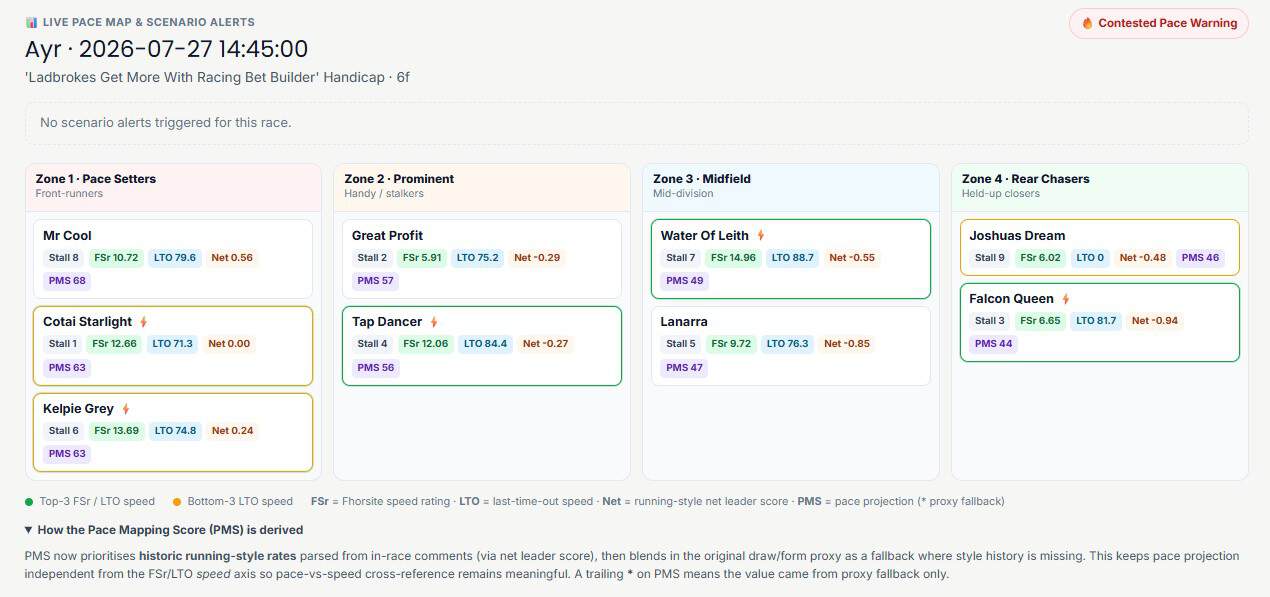
The core engine driving our visual pace map is the Pace Mapping Score (PMS). Unlike basic pace systems that rely purely on finishing positions, PMS evaluates independent data axes to give you a pure look at a race’s shape.
Parsed In-Race Comments
The engine prioritizes highly specific running-style rates mathematically parsed from a horse’s past historical data. This establishes a baseline running profile independent of standard speed and class ratings.
The Draw and Form Proxy
If a horse has a blank history or is switching disciplines, the system deploys an original draw and form proxy as a fallback mechanism. If you see a trailing asterisk (*) next to a horse’s PMS score on your card, it tells you that the system utilized this proxy backup. This keeps the pace map fully functional even when data gaps exist.
How to Exploit Automated Scenario Alerts
You don’t need to spend hours cross-referencing tables. Our interface features intelligent data triggers at the top of your card to alert you to massive tactical advantages or hazards instantly:
Contested Pace Warning
Triggered automatically when Zone 1 (Pace Setters) contains multiple high-velocity front-runners. When multiple horses aggressively fight for the early lead, the pace collapses late. This scenario heavily upgrades the deep closers sitting quietly back in Zone 4.
Vulnerable Leader Alert
This alert fires when a horse is projected to lead the field early based on its running style, but possesses bottom-3 Last-Time-Out (LTO) raw speed ratings. This tells you the horse will likely set the early pace but gets swallowed up late by the field—making them highly profitable false favorites to bet against.
Spotting Pace Value on Fhor.site
To secure an elite handicapping edge using our live pace map interface, follow this 3-step checklist on today’s cards:
Step 1: Scan for the “Lone Speed”
Look for fields where only a single horse occupies Zone 1 (Pace Setters) while the rest sit in Midfield or Rear Chasers. A lone front-runner can dictate an incredibly slow tempo, save vital respiratory energy, and sprint away at the finish line completely uncontested.
Step 2: Cross-Reference FSr and LTO
Check the inner cards for the top-3 color indicators. A Zone 1 Pace Setter holding a green top-3 Fhorsite Speed Rating (FSr) and high LTO numbers is the most dangerous asset in racing.
Step 3: Attack Pace-vs-Speed Overlays
When a Contested Pace Warning tells you the front-runners will kill each other off, scan Zone 4 for a hold-up horse holding an undervalued market price. You are betting on the high-probability race shape, giving you an immense mathematical edge over the casual public.